Matt Aitchison says a new law in California, SB 1079, will result in the State entering the real-estate-foreclosed home business, which essentially removes competition from investors, and could ultimately socialize real estate as a whole.
The new law permits eligible bidders, including tenants, families who plan to use the property as their primary residence, non-profits, land trusts and local governments to buy the homes, but they must pay up in cash when bidding. Under the new law, cities are allowed to fine owners $2,000 per day for blighted property. Because most people cannot pay cash for a home, that puts government in the front of the line to buy the properties.
SB1079 in California is considered, by many, to be the best opportunity for investors and small lenders in 2021 and into the foreseeable future. This bill which came into effect on January 1, 2021, created a legal mechanism whereas an ‘eligible tenant buyer’, ‘prospective owner-occupant’, or a non-profit may purchase a 1-4 unit property after a foreclosure auction. It was (poorly) designed for renters subject to landlords who did
not pay the mortgage.
The primary advantage for investors is that financing may be used to purchase the property. Widely viewed as picking the winning race horse after the race. Small investors who qualify with a non-profit and get financing will have considerable opportunity while not being required to have certified funds on the courthouse steps. The action to take advantage of this opportunity is spelled out on the
Notice of Sale, as required by new statutes, and is handled by the foreclosure Trustee. No bank, no homeowner redemption, and no agents or brokers!
SB1079 does allow for government entities, limited-equity housing cooperatives and community land trusts to purchase property. This is not anticipated to ever happen and ‘eligible tenant buyers’ are not expected to possess the means to purchase property. Many larger funds will find frustration if their funding does not allow them to purchase in such a manner (as they are not a non-profit) but may still purchase on the courthouse steps, as many have for years, but now ‘risk’ someone else
acquiring said property post-sale. Foreclosing lenders are not expected to experience negative effects, as they receive the same amount of money as they would expect at the foreclosure sale with minimal negative impacts to timelines. Those expected to receive the most negative consequences of this bill would be real estate agents and brokers as this legal mechanism removes the necessity of them being involved with the new entity or homeowners gaining ownership.
As many are aware, ‘non-profit’ does not mean no profits. So far, this has not really picked up any attention as some professionals are still scrambling to get their non-profit status, while COVID protocols, institutional moratoriums, and an inability to evict tenants/former homeowners has temporarily prevented or disincentivized most foreclosure sales from moving forward. Once the foreclosure sales pick up, a lot more purchases, pursuant to SB1079, are anticipated.
Reality is that the long term effects on the housing markets are unknown but this bill is not anticipated to result in lower overall prices but rather create considerable individual opportunities for appropriately qualified and financed buyers who would otherwise not be able to buy with certified funds on the courthouse steps. The removal of agents and brokers is seen as refreshing for many investors. Banks are likely to eliminate a ‘low/high’ bid but rather use their highest or best pricing
at auction. The days of looking at sales results wishing that one was there may now be a thing of the past and investors will not miss the days of standing at the courthouse steps, certified funds in hand, waiting to hear if a deal is postponed at the last minute.
Matthew Kelley
Special Default Services
Irvine, CA
Direct: 949.310.9736
MKelley@specialdefaultservices.com
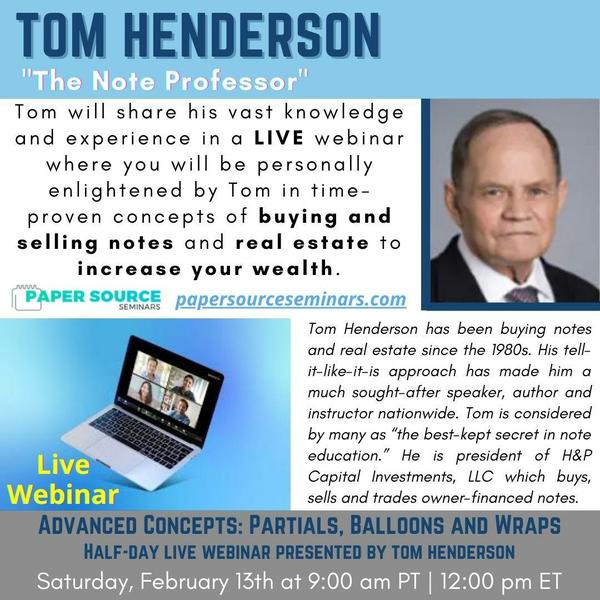
“The Note Professor”™️ Tom Henderson will teach Advanced Concepts: Partials, Balloons and Wraps in a Half-Day LIVE Webinar.